


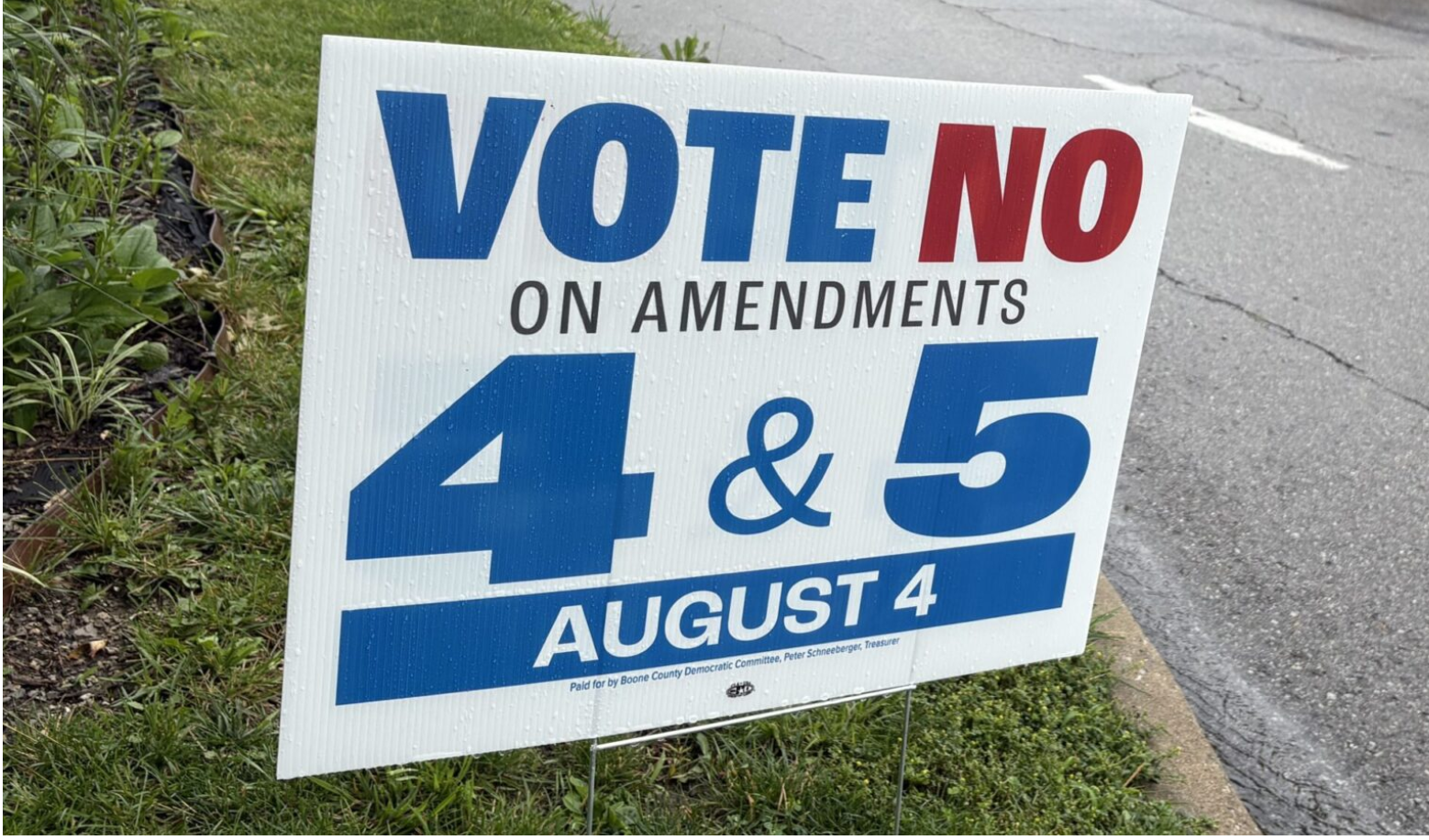
BY: RUDI KELLER
Missouri Independent
Missouri voters resoundingly rejected major Republican priorities on Tuesday as proposals to eliminate the income tax and change the way initiative petition majorities are counted lost by large margins across the state.
The Associated Press called the race for both amendments at 8:15 p.m., with Amendment 4 losing by 63 percentage points and Amendment 5 down 67 percentage points.
Two other statewide ballot questions, Amendment 1 and Amendment 2, were projected to pass easily.
Amendment 1 extends the 0.1% sales tax that supports state parks and soil and water conservation. Amendment 2 will require that all county tax assessors be elected officials and affects only Jackson County.
Gov. Mike Kehoe, while projecting optimism about the chances for both amendments after voting Tuesday morning, said defeat was not the end, especially for the project to eliminate the income tax embodied in Amendment 5.
“I’m going to always look for ways to make the burden of government less on Missouri families and let them keep more of their own money,” Kehoe said.
Any discussion of tax changes needs input from across the political spectrum, people attending an election-night party in Jefferson City at the Missouri Association of Realtors office. The Realtors spearheaded the coalitions that defeated the two amendments,
At the Ashland Optimist Club in Boone County, there was a steady stream of voters but little in the way of the usual jungle of campaign signs with a last appeal for candidates. There were some candidate primaries, but none that have generated wide interest and most voters wanted to talk about Amendments 4 and 5 as their motivation to vote.
Alan Helland said he opposed Amendment 4 because the initiative process is a way to check unlimited political power.
“It’s necessary, especially in a very partisan environment,” he said.
Voter Steve Morton said he didn’t like the prospect of higher sales taxes that could have been the result of Amendment 5 passing.
“It’s going to tax away more than what my property tax and stuff is going to be expensive,” he said. “So I don’t want to pay more for everything else.”
The idea of eliminating the state income tax and raising revenue through sales tax appealed to Chad Cole, who said he voted for Amendment 5.
Cole said he expects to pay less in new sales tax than he would in income tax and that will boost the economy.
“I’ll have more money to spend,” he said.
The election was important enough that it brought Macie Reynolds, 18, to the polls for the first time. Outside the Optimist Club building, she hugged her father, Jason Reynolds, as they took a selfie to record the moment and her mother, Dana Reynolds, looked on.
They studied the ballot to prepare, she said.
“We just kind of talked through it and decided what priorities mattered to us, and kind of went with that,” Reynolds said.
What they decided, however, she would not say.
“I’ll keep that to myself,” she said.
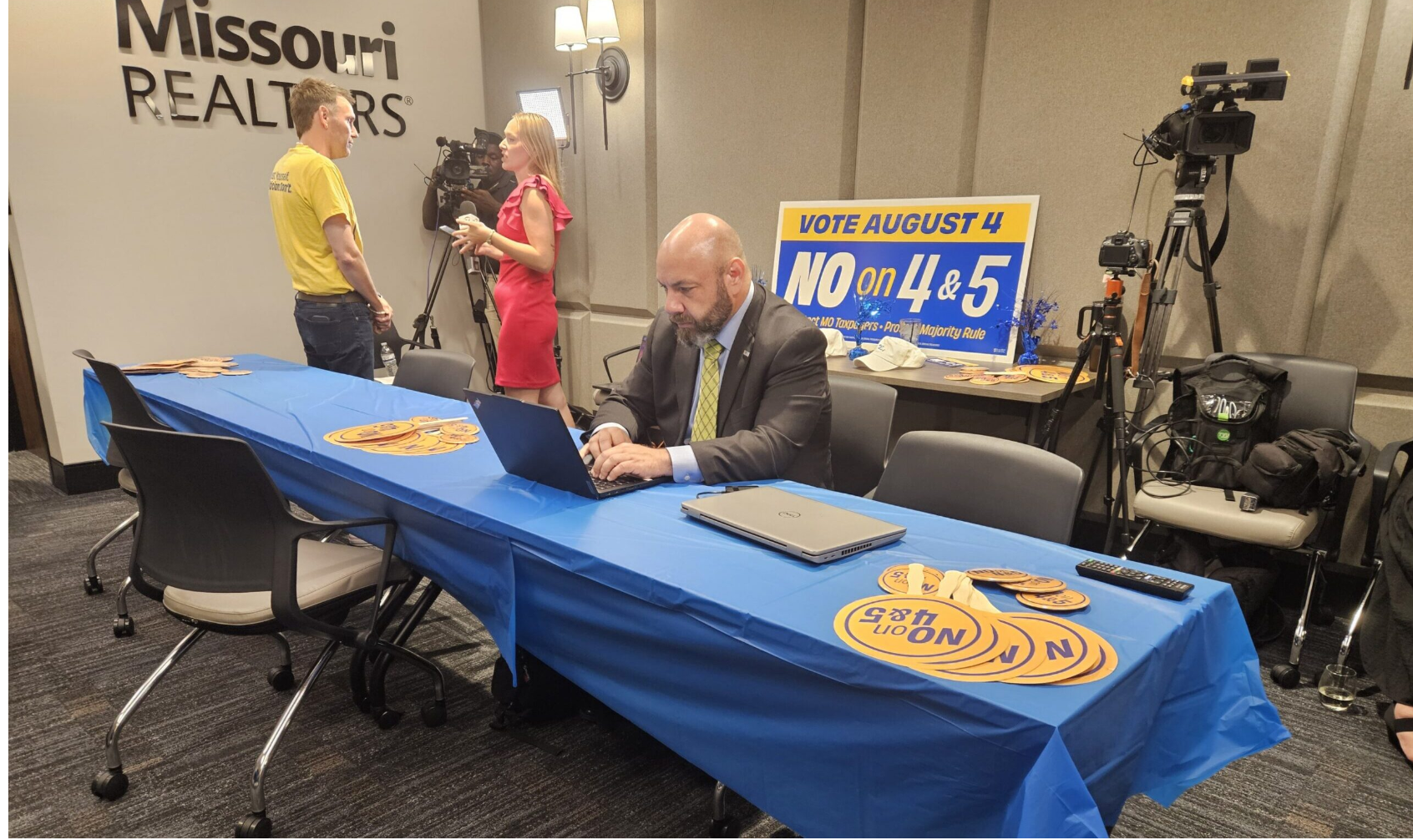
The defeat of both amendments was engineered by the Missouri Association of Realtors and coalitions of activist groups on the left and right. During legislative deliberations on both measures, the Realtors made clear their group would provide funding and organizational strength to the opposition campaigns.
The Realtors have used the initiative petition process twice to amend the constitution. In 2010, the organization spent $4.3 million to pass a ban on taxing real estate transactions and, in 2016, $5.6 million later to ban any expansion of goods or services subject to sales tax.
“If we were willing to spend that much a decade ago, we are certainly going to fight to protect it,” Realtor lobbyist Jason Zamkus said after testifying against the income tax replacement bill that became Amendment 5.
Proponents of Amendment 5 came to the fight prepared and outspent opponents by a more than 2-to-1 margin and by an almost 4-to-1 margin in broadcast ads, according to The Independent’s tracking of state and federal campaign reports.
Missouri Promise PAC, the pro-Amendment 5 political action committee funded entirely by groups that do not disclose their donors, doubled its ad spending in many markets in the final week of the campaign in an effort to close the gap.
Opponents of Amendment 4 had the field almost to themselves in terms of big campaign spending. In addition to the group funded by the Realtors, another opposition committee, Protect Majority Rule Missouri, raised $6.8 million and shared a website with the Realtors-backed committee.
The Realtors contributed $2.8 million to Missourians for Fair Taxation for the campaign to defeat Amendment 5 and $4.4 million of the $4.5 million in cash donations to Missourians for Fair Governance to defeat Amendment 4.
The funding for both campaigns generated some last-day sniping as Kehoe complained about the source of money for the opposition groups. Asked for a response, Scott Charton, a spokesman for both opposition campaigns, said Kehoe should be more careful with his criticism.
“No. 1, it’s easy to say no to anything,” Kehoe said. “No. 2, whoever’s putting a lot of money into that campaign obviously has some tax benefits and things that they like right now. I’m not saying that’s good or bad, but that’s usually how that works.”
Promoters of Amendment 4 tried to make it a grass-roots campaign, Kehoe said.
The opposition to Amendment 4 came from “the outside interest groups who like to change our constitution, and we’ve seen it happen in 2020, 2022, 2024, where lots of outside money came to change our state’s constitution,” Kehoe said. “The whole point about Amendment 4 is our constitution should not be for sale.”
Asked if the Realtors are an “outside group,” Kehoe said they are “a special interest group, but there’s other funding coming from outside of the state for both of those questions, (Amendments) 4 and 5.”
Charton disputed the label.
“Helping working Missourians achieve the American Dream of homeownership for all is hardly a special interest,” he said. “It is everyone’s interest.”
The money the Realtors put into the campaigns against Amendments 4 and 5 came from the 25,000 Realtors throughout the state, Charton said.
The money funding Missouri Promise is not disclosed.
“The source of Realtors’ money is Realtors,” Charton said, “but I cannot speak for the dark money groups who never recorded a single individual human donation from a Missourian.”